Free shipping from 60 € in Germany, from 100 € in Europe – Enjoy your shopping!
Kostenloser Versand ab 60 € in Deutschland, ab 100 € in Europa - Genießen Sie Ihren Einkauf!🇪🇺🇩🇪
Kostenloser Versand ab 60 € in Deutschland, ab 100 € in Europa - Genießen Sie Ihren Einkauf! 🇪🇺🇩🇪
Johanniskrautöl: Naturgeschenk für Haut- und Haarpflege

St. John’s wort oil: nature’s gift for skin and hair care


St. John's wort oil has found its place in our skin and hair care routines and is considered a precious gift from nature. Known for its antioxidant and anti-inflammatory properties, this oil is an excellent choice to promote skin health and relieve skin problems. But what is the history of St. John's wort oil and what benefits does it offer? How is it used and what should you look out for? All the answers to these questions can be found in this article.


How is St. John’s wort oil made?

St. John's wort oil is extracted from the flowers of the St. John's wort plant (Hypericum perforatum). The flowers of St. John's wort are collected and mixed with olive oil through cold pressing to extract the oil. The history of this oil dates back to ancient times, and it has been used for medicinal purposes in many cultures. In medieval Europe in particular, it was widely used to treat wounds and skin problems.


St. John's Wort Oil

The benefits of St. JoSt. John’s Wort oil

St. John’s wort oil offers the following benefits:

  • Skin healing: Thanks to its anti-inflammatory properties, it soothes irritations and fights inflammation. It renews the skin and relieves itching.
  • Skin care: It moisturizes, nourishes and gives the skin a healthy appearance. It also has antibacterial and antiviral properties, which soothes and strengthens the skin.
  • Sunburn and wounds: It is known for its regenerating effect on sunburn and minor injuries.
  • Hair care: It reduces hair loss, supports hair growth, prevents dandruff, promotes scalp cell regeneration and moisturizes the hair, making it appear strong and shiny.


How and how often is St. John’s wort oil used?

Here are some points to consider when using St. John’s wort oil:


Skin application: You can apply 4-5 drops lightly to the affected area or put a few drops on a cotton pad and massage the skin.

Hair care: You can apply it to the scalp, massage gently and leave it on for at least an hour before washing your hair with shampoo.


What should you pay attention to?

St. John's wort oil may interact with certain medications in some people, so consult a doctor before using.


Internal use is not recommended and use without a skin test may cause allergic reactions.


St. John's Wort oil is a natural product with many benefits for skin and hair care. You can help promote your health and beauty by preferring the organic version. Discover this healing gift of nature and enjoy the wonders it offers for your skin and hair!
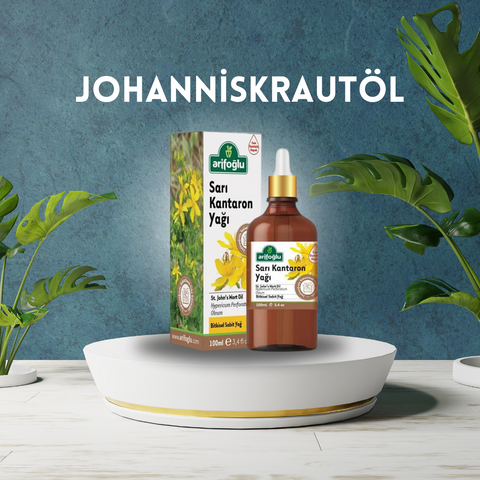

St. John's Wort Oil

Is St. John’s wort oil available in Europe?

Thanks to Arifoğlu Bazaar, you can easily get all the natural oils that support Turkish natural products and your health from Almanya. You can also find St. John's Wort oil within Europe on this website!

Previous post
Next post
Back to Skin Health, Barrier Care & Skincare Routines

Leave a comment

Blog posts

HC Care Haar Complex 100 ml – Pflanzlicher Haarpflegekomplex mit 18 reinen Pflanzenextrakten gegen Haarausfall und für gesundes Haarwachstum

HC Care Hair Complex – The comprehensive guide to plant-based hair care & regeneration

Discover the HC Care Hair Complex: This patented intensive treatment, featuring 18 pure plant extracts, strengthens hair roots, promotes healthy growth, and noticeably repairs damaged hair from the inside out.

Read more
Naturbelassene goldene Sesamsamen und geöffnete Samenkapseln auf Schieferstein: Reich an pflanzlichem Kalzium und Mineralien für stabile Knochen.

Plant-based calcium of the highest quality: The mineral matrix of sesame and its importance for bone health

Sesame as a plant-based source of calcium: why sesame seeds provide up to eight times more calcium than cow's milk, how stone-ground tahini bypasses phytates, and which mineral matrix facilitates...

Read more
Vergleich traditioneller Halva-Sorten: Handwerkliche Tahin-Halva mit Pistazien, warme Mehl-Helva und körnige Grieß-Halva auf rustikalem Hintergrund.

What is halva? The difference between flour, semolina, and tahini halva.

What exactly is halva? Discover the differences between flour, semolina, and tahini halva, the quality standards of brands like Koska and Seyidoğlu, and the benefits of Gökova sesame and stone-ground...

Read more
Türkischer Oregano

Turkish Oregano vs. Other Oregano: Why Anatolian Mountain Oregano Is the World Leader

What makes Turkish mountain oregano (*Origanum onites*) the undisputed number one worldwide? Discover the crucial difference between it and common oregano or thyme, the impact of the extreme Taurus climate...

Read more
Historisches Stillleben mit antiker Papyrusrolle, handgefertigter Tonschale voller Flohsamenschalen (Psyllium / Karnıyarık Otu) und altem Arzneibuch zur Medizingeschichte von Plantago ovata

From Ancient Egyptian Papyri to the Silk Road: The Millennia-Old Journey of Discovery of Psyllium

How did psyllium husks (Psyllium / *Karnıyarık Otu*) make their way from ancient Egyptian papyri and Indian Ayurveda to Europe via the historic Silk Road? Discover 3,500 years of medical...

Read more
Laboranalyse von kaltgepresstem Schwarzkümmelöl mit Nigella-Sativa-Samen, Pipette und bernsteinfarbenem Öl auf Schieferplatte zur Bestimmung des Thymochinongehalts

Thymoquinone (TQ) in the Lab: How to Determine the Quality of Black Seed Oil?

How do you recognize first-class black seed oil? Find out why thymoquinone content (TQ) is the most important biochemical measure of quality and efficacy. From the peroxide value to genuine...

Read more